Here's a fun new widget for the computer or iPhone, you can track your garden's growth and progress through the website myfolia.com. Beyond being a handy online garden journal, it also allows you to use its timeline function in order to track the progress of each of your plants or crops as well as interact with other online gardeners. Let us know if you try it out and what you think!
-Tina Mast, Communications Director
Friday, May 8, 2009

Thursday, April 23, 2009
Working Color Into the Garden
A customer asked me this question yesterday,"Do I have to plant the same flowers everwhere? I feel like my garden is all green, green, green right now, and someone told me to plant flower but that I had to plant a lot of them everywhere for it to look right? Do I have to do that?"
"Absolutely not," I said, "You're talking to a nurseryperson and we're the Original Plant One of Everything type of gardener. The thing is there is an element of truth there about planting more than one of something, and it's that weaving a color throughout the garden will make the effect more cohesive and will pull it all together. Now, do you have to plant 20 of the same thing to achieve that effect? No! Take me, for example, I like plants with burgundy foliage. Do I plant 50 of the same burgundy-leafed heuchera around the garden. Nope. But, I look for other plants with the same color in them: loropetalum, purple wood spurge, coleus, alternanthera, etc. in order to bring that color through the garden without having to plant the same thing. So, just think of it that way and you can have variety without ending up with a complete hodge-podge in your garden."
 -Tina Mast , Communications Director
"Absolutely not," I said, "You're talking to a nurseryperson and we're the Original Plant One of Everything type of gardener. The thing is there is an element of truth there about planting more than one of something, and it's that weaving a color throughout the garden will make the effect more cohesive and will pull it all together. Now, do you have to plant 20 of the same thing to achieve that effect? No! Take me, for example, I like plants with burgundy foliage. Do I plant 50 of the same burgundy-leafed heuchera around the garden. Nope. But, I look for other plants with the same color in them: loropetalum, purple wood spurge, coleus, alternanthera, etc. in order to bring that color through the garden without having to plant the same thing. So, just think of it that way and you can have variety without ending up with a complete hodge-podge in your garden."
 -Tina Mast , Communications Director
Monday, April 6, 2009
Why the Phrase "Excavate the Root Collar" is Important if You're Planting
Sounds technical but it really isn't. The "root collar" is the part of a wood tree or shrub where the trunk meets the beginning of the roots. It's an important area because if it's planted too deep or a lot of mulch or debris rests against it, the plant can get stem rot and actually die from it. Death by mulch. That can kill a tree?? Sounds implausible but it's true!
So, if you don't plant the plant too deep, no problem, right? NOT necessarily. If the plant was grown in a container, it may have had soil or mulch added over the roots. The roots may have responded by growing up PAST the root collar into this area. Then, when you plant and make the soil from the pot even with the surrounding soil, something that you are always told to do, guess what? You planted it too deep! Unless, that is the root collar was already exposed when you planted it.
What to do? Check before you plant. You may have to actually excavate the area around the root collar. This may involve merely brushing away excess soil and/or mulch. Or, this may mean you actually cut away portions of the rootball. This actually seems more brutal than it is and the plant will be fine. The plant will be very happy you did that, in fact. A pruning saw works well for this or a very sharp knife.
So, now you know. Go forth and plant thy trees and shrubs...and don't forget the pine bark soil conditioner in your clay soils!
Tuesday, March 31, 2009
New Device Allows Plants to Twitter
Forget about whether it's weird for you to talk to your plants (it's not, they like it) but what about your plants talking back? Well, we're one step closer with a new device called Botanicalls which lets your plants send you Twitter messages when they're thirsty (or, conversely, want you to slack off the overwatering, you worrywart).
Check it out:
http://www.reuters.com/article/smallBusinessNews/idUSTRE52U42B20090331
Check it out:
http://www.reuters.com/article/smallBusinessNews/idUSTRE52U42B20090331
Thursday, February 19, 2009
Sir Walter Wally don't know jack!
You just can't trust a groundhog to forecast the weather. I don't care if it's going to snow three more times this winter, I can still tell that spring is on its way. All I have to do is wait for the Okame cherries to bloom. And they have just exploded into gorgeous clouds of pink.
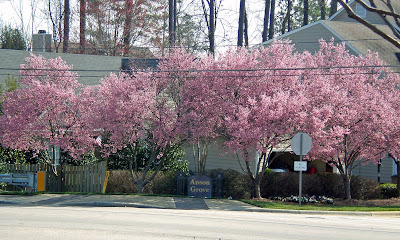 Every year we get tons of phone calls about these lovely specimens on Durant Road. Most people are more familiar with the bright white blooms of Yoshino cherries or the puffy, pink blooms of the Kwansan cherries, so the early-blooming Okames confuse the heck out of them. But, here at Homewood, we've known and loved Okames for years.
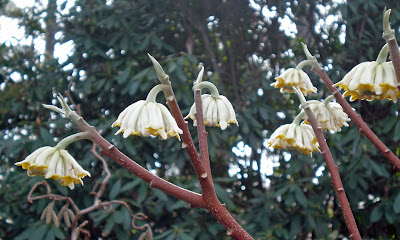
Also on our list of favorite, not-well-known bloomers is the Cornelian Cherry Dogwood (Cornus mas) that lights up the nursery courtyard each February like it did last year... and this year
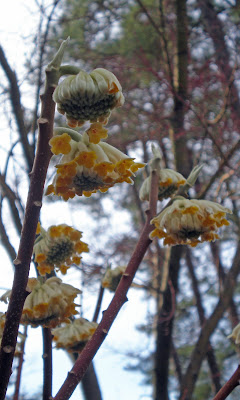
 And I can't leave out the Golden Paperbush (Edgeworthia) whose furry silver buds tease us all winter at the tip of each branch,
 then open right about now to fill the air with a light, honey-like fragrance.
 Every year we get tons of phone calls about these lovely specimens on Durant Road. Most people are more familiar with the bright white blooms of Yoshino cherries or the puffy, pink blooms of the Kwansan cherries, so the early-blooming Okames confuse the heck out of them. But, here at Homewood, we've known and loved Okames for years.
Also on our list of favorite, not-well-known bloomers is the Cornelian Cherry Dogwood (Cornus mas) that lights up the nursery courtyard each February like it did last year...
and this year And I can't leave out the Golden Paperbush (Edgeworthia) whose furry silver buds tease us all winter at the tip of each branch, then open right about now to fill the air with a light, honey-like fragrance.That groundhog in his hole just doesn't know what he's missing.

Wednesday, February 18, 2009
Can You Plant Now? Yes, You Can!
We've been getting a lot of is-it-okay-to-plant-now questions, and the short answer is yes! (with an "as long as" to follow) You can plant hardy trees and shrubs in our part of NC any time of year as long as the ground is not frozen or saturated with water (like it is today). Our ground rarely stays frozen for long, so you can pretty much plant year round here.
What are the best times to plant? Fall is the best season to put in hardy trees and shrubs. Early spring (or even late winter) is the next best time. Non-hardy plants such as most flowering annuals (think petunias and impatiens)and warm season vegetables like tomatoes shouldn't be planted until mid-April or later.
If you do decide to plant and you have heavy clay soil, make sure you amend with Permatill or pine bark soil conditioner to break up the clay and help it stay aerated. Also, make sure when planting woody trees and shrubs that the "trunk flare" is exposed and is planted at or slightly above ground level. Sometimes, the flare at the bottom of the main woody stem or trunk can get buried under mulch or soil in a container-grown plant. It's absolutely vital that this part does not subsequently get planted below ground. This can greatly shorten the lifespan of the plant.
p.s. If you're in the mood to plant, Homewood just got in our first shipment of azaleas, rhododendrons, and pieris. And, there's plenty more to come in the next couple weeks including winter daphne and some "phat" camellias(according to Assistant Nursery Manager, Christina)

Tina Mast
Communications Director
What are the best times to plant? Fall is the best season to put in hardy trees and shrubs. Early spring (or even late winter) is the next best time. Non-hardy plants such as most flowering annuals (think petunias and impatiens)and warm season vegetables like tomatoes shouldn't be planted until mid-April or later.
If you do decide to plant and you have heavy clay soil, make sure you amend with Permatill or pine bark soil conditioner to break up the clay and help it stay aerated. Also, make sure when planting woody trees and shrubs that the "trunk flare" is exposed and is planted at or slightly above ground level. Sometimes, the flare at the bottom of the main woody stem or trunk can get buried under mulch or soil in a container-grown plant. It's absolutely vital that this part does not subsequently get planted below ground. This can greatly shorten the lifespan of the plant.
p.s. If you're in the mood to plant, Homewood just got in our first shipment of azaleas, rhododendrons, and pieris. And, there's plenty more to come in the next couple weeks including winter daphne and some "phat" camellias(according to Assistant Nursery Manager, Christina)

Tina Mast
Communications Director
Wednesday, January 14, 2009
Get Your Garden Ready for the Cold Snap
Looks like we're going to have one those once-in-a-blue-moon-moon snaps that has the potential to do significant damage in the garden. You can help mitigate the damage by doing the following:
- Mulch over the root zones of trees and shrubs, and over the crowns of dormant perennials. A 4" layer should be adequate. (Make sure to remove mulch from plant crowns just before growth resumes in spring, and make sure mulch does not rest against the trunks and stems of woody plants.)
- Cover any damage-prone plants such as aucuba, oleander, euonymus, gardenia, ternstroemia, osmanthus as well as any that are in bloom or have buds that are opening such as camellia and daphne. Old blankets make good plant covers. Plastic is not the best choice but tarps are not bad. Sheets are fine but not as protective as a thicker material.
- Bring in container plants and store them in the garage or under the house. If you don't have room for that, huddle the pots together against the house, preferably on a sunny south or west side, and cover them up.
- If you have time, you can put Christmas lights on susceptible plants to add some warmth. These can go under a covering such as a blanket for even more protection.
- Water evergreen plants before freezing weather sets in. This will help prevent them from dessicating. Evergreens can't take up water when the soil is frozen but they continue to lose moisture through their leaves.
- Bring in hoses and glazed pots. Some glazes will crack and peel as a result of freezing weather especially if it rains. Hoses will last a lot longer if they don't get frozen and thawed all winter.

Tina Mast
Communications Director
- Mulch over the root zones of trees and shrubs, and over the crowns of dormant perennials. A 4" layer should be adequate. (Make sure to remove mulch from plant crowns just before growth resumes in spring, and make sure mulch does not rest against the trunks and stems of woody plants.)
- Cover any damage-prone plants such as aucuba, oleander, euonymus, gardenia, ternstroemia, osmanthus as well as any that are in bloom or have buds that are opening such as camellia and daphne. Old blankets make good plant covers. Plastic is not the best choice but tarps are not bad. Sheets are fine but not as protective as a thicker material.
- Bring in container plants and store them in the garage or under the house. If you don't have room for that, huddle the pots together against the house, preferably on a sunny south or west side, and cover them up.
- If you have time, you can put Christmas lights on susceptible plants to add some warmth. These can go under a covering such as a blanket for even more protection.
- Water evergreen plants before freezing weather sets in. This will help prevent them from dessicating. Evergreens can't take up water when the soil is frozen but they continue to lose moisture through their leaves.
- Bring in hoses and glazed pots. Some glazes will crack and peel as a result of freezing weather especially if it rains. Hoses will last a lot longer if they don't get frozen and thawed all winter.

Tina Mast
Communications Director
Subscribe to:
Posts (Atom)

 Posts


